

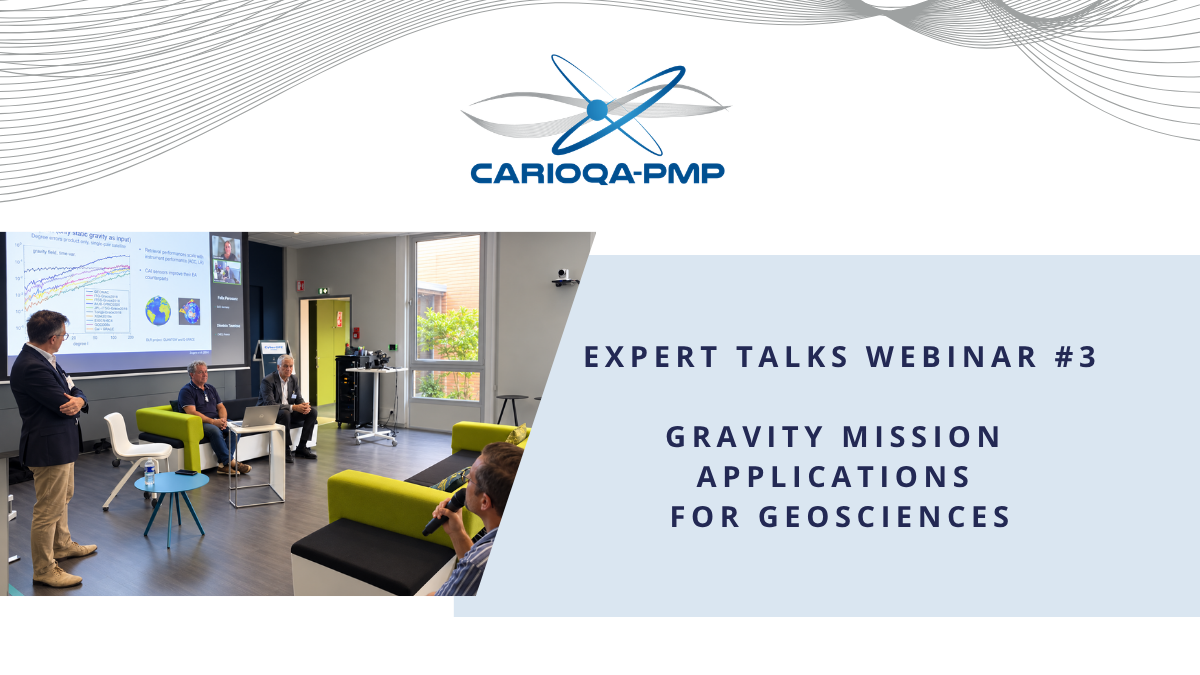
The third CARIOQA-PMP webinar, titled “Gravity Mission Applications for Geosciences,” was successfully conducted on 6th October 2026, featuring a hybrid format that combined in-person attendance at CNES, Toulouse with virtual participation via Zoom to enable broad engagement from both on-site and remote audiences.
In this webinar we explored gravity mission applications for geosciences, highlighting their potential in understanding the dynamics of the Earth system . The discussion underscored several important insights:
1. The current state of the art in space gravimetry was reviewed, including missions like CHAMP, GOCE, GRACE, and GRACE-FO, which have provided crucial data over the last 25 years to observe the static and time-varying gravity field, including continental water storage, ice sheet mass loss, global ocean mass changes, as well as internal process during all phases of seismic cycle.
2. Gravity field information can be considered as a mirror of the Earth’s surface and deep interior mass distribution. Indeed, the satellite gravity data can detect anomalous gravity gradient changes occurring months before major earthquakes, such as the period leading up to the 2011 Tohoku earthquake.
3. Satellite accelerometers are used to separate non-gravitational forces such as atmospheric drag and solar radiation pressure. An accelerometer placed precisely at the satellite’s center of mass measures everything except gravity. It is then possible to isolate the non-gravitational forces and deduce the gravitational field from an analysis of the satellite’s trajectory. Compared to conventional systems, future space-based quantum CAI sensors are expected to overcome technological bottlenecks of the current electrostatic accelerometers. These instruments will be essential for meeting the scientific requirements of future gravity field models.
CARIOQA-PMP extends its warm thanks to Jürgen Müller (LUH), Isabelle Panet (IGN / Université Paris Cité), and Jean-Michel Lemoine (CNES), who served as expert panelists, and to Félix Perosanz (CNES) for moderating the discussion.
Missed the webinar or want to revisit the key insights? Watch the full replay on the CARIOQA-PMP project’s YouTube channel :