

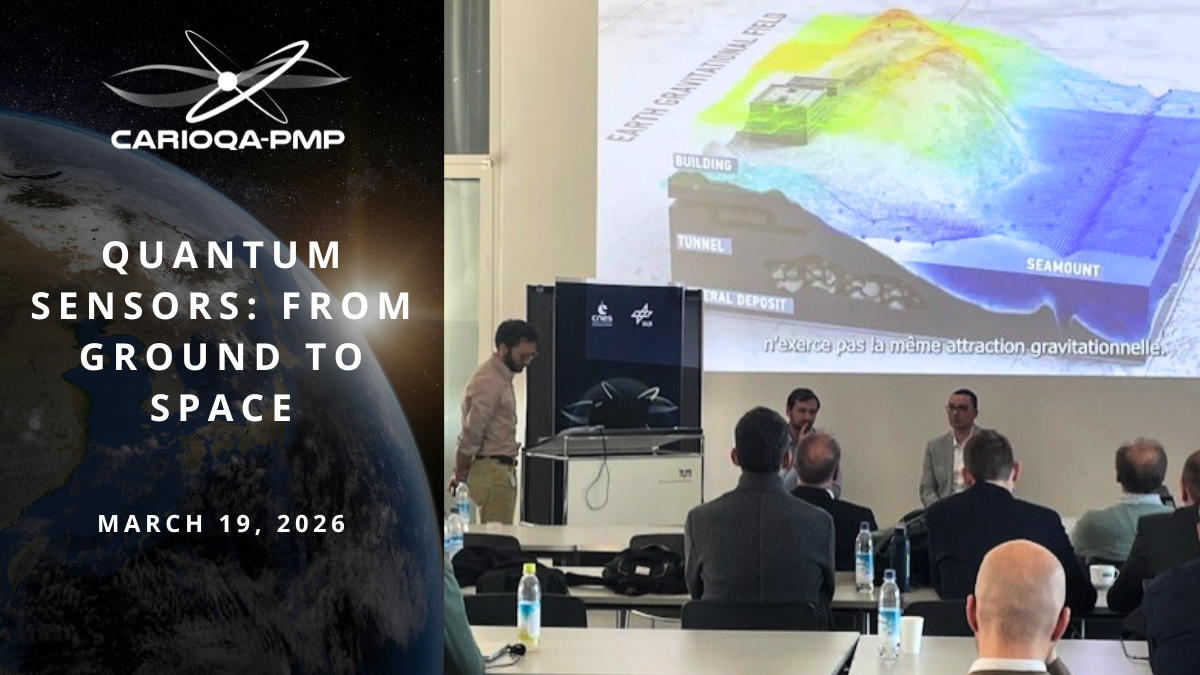
The second CARIOQA-PMP webinar, titled “Quantum Sensors: From Ground to Space,” was successfully conducted on March 19, 2026, in a hybrid format that seamlessly combined in-person participation at TUM with virtual attendance via Zoom, enabling broad engagement from both on-site and remote audiences.
In this webinar we explored the rapidly evolving field of quantum accelerometers for space applications, highlighting their potential in Earth observation and fundamental physics.
The current state of the art was reviewed, including the Cold Atom Lab (CAL) on the International Space Station (ISS), which studies ultra-cold quantum gases in microgravity. Despite this progress, space-qualified quantum accelerometers remain in early development.
Key instrument components were discussed, such as cold atom sources, laser systems, microwave fields, vacuum chambers, and ultra-stable electronics—all requiring adaptation for space conditions.
Compared to ground-based systems, space-based sensors must operate autonomously in microgravity. Major challenges include increasing atom flux, compensating for satellite motion, and ensuring robustness. A critical trade-off exists between instrument sensitivity and cost. Environmental disturbances—radiation, temperature variations, and vibrations—pose additional risks, requiring mitigation strategies like shielding and thermal control.
Finally, the importance of dedicated satellite platforms and microgravity test environments (e.g., drop towers, aircraft, sounding rockets, and the ISS) was emphasized, along with the need to translate laboratory experiments into reliable space systems.
CARIOQA-PMP extends its warm thanks to Naceur Gaaloul (LUH), Stephan Seidel (AIRBUS) and Lisa Wörner (DLR), who served as expert panelists, and to Thomas Lévêque (CNES) for moderating the discussion.